|
http://www.heraldandnews.com/articles/2006/07/01/news/local_news/local1.txt
Project
aims to mend lake shore
 |
H&N photo by Andrew Mariman
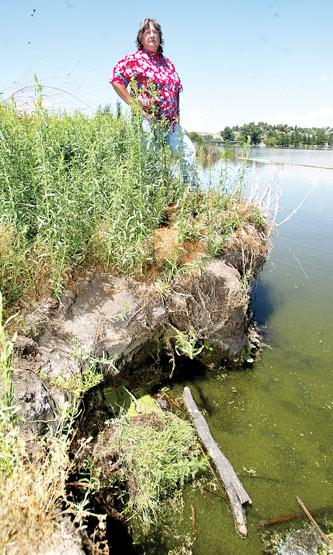
Waves and burrowing animals have caused
erosion along the shores of Lake Ewauna.
Dani Watson of OSU Extension Service is
heading a plan to stop it. |
|
July 1, 2006 by Steve Kadel,
Herald and News
Waves and burrowing animals have carved deeply into
Lake Ewauna's shore.
But a test program this fall
might be the cure. The Lake Ewauna Wetland
Enhancement Project will use a rock wall to slow
wave action and prevent erosion.
The bank, which often is at 90 degrees or undercut
in concave fashion, will be reshaped to slope up at
a 45-degree angle. That's intended to thwart
muskrats and other animals' attempts to burrow.
Vegetation will be planted where the bank slope is
changed.
Repair work along the Wingwatchers' trail is headed
by Dani Watson of the Oregon State University
Extension Service and Klamath Watershed Council.
“Historically they've put log booms out,” she said.
“It stops the top level of water.”
But that does nothing to water surging toward land
under the logs. Thus the wall extending from what
Watson calls “a nice hard pan” on lake bottom up to
the water surface.
A 120-yard section of
shoreline will be treated as a test. If it works - a
determination that will take a few years - more of
the lake's shore will be treated, Watson said.
“We'll have a clue after a
year, but not a definitive answer,” she said.
The wall will be about 30 yards offshore in 2 feet
of water. An excavator will be used to put rocks
into the water. The operator must place the rocks
carefully to avoid stirring up sediment, Watson
said. The test project will cost $50,000, including
engineering design and a consultant's advice. It's
measured by three gauges placed at three shoreline
locations.
Mark Buettner, a fisheries biologist for FWS,
acknowledged the lake level does not currently meet
the biological opinion's requirement. But he said
the agency has OK'd the temporary discrepancy, which
was due to circumstances beyond Reclamation's
control.
Analyses by Reclamation and
FWS conclude the current level will provide adequate
sucker habitat this year.
Lake water that filled Caledonia Marsh will likely
stay there at least until fall, Buettner said.
Pumping it back into Upper Klamath “wasn't deemed
practical” because of the cost and difficulty of the
task, he said.
Meanwhile, Reclamation officials have called on
water bank suppliers to pump well water into the
irrigation system.
“We have everything available turned on and running
for us,” said Cecil Lesley, chief of Reclamation's
water and land division. “We will continue (using)
the water bank until it's gone or we match the
required elevation in the lake.”
Another factor in
reaching the desired level begins today, when the
amount of Klamath River water flowing through Iron
Gate dam in California will be reduced by about
two-thirds.
Flow requirements called for 2,900 cubic feet of
water per second to course through the dam. However,
that number dropped to 1,000 CFS at midnight Friday.
Lesley estimated it
will take about nine days to make the transition.
Reclamation spokeswoman Rae Olsen noted “seasonal
inflows” to Klamath Lake have been lower than
anticipated. The situation might be caused by low
groundwater levels from several years of drought,
she said.
However, things look good for irrigators this
summer, said Reclamation's acting area manager
Christine Karas.
“We do not anticipate any shortages to the Project,”
she said. “The Fish and Wildlife Service is really
working with us on this.” |